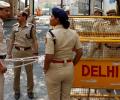
Delhi Police has arrested another accused in connection with an ongoing investigation into an espionage racket linked to Pakistani intelligence operatives (PIOs), an official said on Saturday.
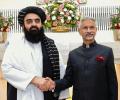
'Pakistan is uncomfortable with the Indian presence in Afghanistan. They want the Taliban to ensure that there is no Indian presence in Afghanistan.'

The nation will always remain indebted to them for their supreme sacrifice and devotion to duty, the official added.

Tahawwur Rana, accused in the 2008 Mumbai terror attacks, has renewed his plea for a stay on his extradition to India, citing health concerns and alleging potential torture. He argues that his extradition would violate US law and the UN Convention Against Torture. Rana's lawyers claim he is at risk of being subjected to torture in Indian detention facilities due to his Pakistani origin, Muslim religion, and medical conditions. The US Supreme Court had previously denied his emergency bid for a stay, but he has now appealed to Chief Justice John Roberts. The US government has declined to provide information on any commitment from India regarding Rana's treatment, further fueling his concerns.

Pakistan has denied any connection to Tahawwur Rana, a key accused in the 2008 Mumbai terror attacks. Rana, a Canadian national, has not renewed his Pakistani documents for over two decades, according to the Foreign Office spokesperson.

While six of them have been held from Punjab, five were nabbed from neighbouring Haryana, and one from Uttar Pradesh.

'My adrenalin kicked in and the happiness returned! It was time to go in for the kill again.' IAF Veterans Group Captain Dilip Kumar Dass tells Air Commodore Nitin Sathe about how the IAF decimated tanks in the famous Battle of Longewala.
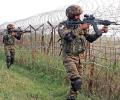
This marked the sixth consecutive night of ceasefire violations by Pakistan along the LoC, amidst heightened tensions between New Delhi and Islamabad following a recent terror attack in Pahalgam on April 22.
Pakistan troops have violated the ceasefire agreement for the 11th consecutive night, firing on Indian posts along the Line of Control (LoC) in Jammu and Kashmir. The firing began in Kupwara and Baramulla districts and spread to other sectors, including Poonch, Rajouri, Mendhar, Naushera, Sunderbani, and Akhnoor. The Indian Army responded promptly and proportionately. The ceasefire violation comes despite a recent phone call between the Directors General of Military Operations (DGMOs) of India and Pakistan on April 29. This marks the latest escalation of tensions between the two countries, following a terror attack in Pahalgam in April.

"The Pakistani army initiated unprovoked and indiscriminate firing of small arms, automatic weapons and mortars from 0515 hours in Poonch sector along the LoC," a defence spokesman said.
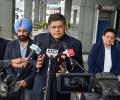
'It is high time that the 'war on terror' is removed from our diplomatic toolbox.' 'Certainly, our parliamentarians have no role in it,' asserts Ambassador M K Bhadrakumar.

The Indian Army responded in a measured and effective manner to the provocation.
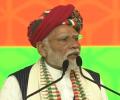
Prime Minister Narendra Modi issued a stern warning to Pakistan, stating that their government and Army are supporting terrorism for their own benefit and urging the people of Pakistan to come forward and end the menace. He also highlighted India's rise to become the world's fourth-largest economy, contrasting it with Pakistan's situation.

The action comes in response to ceasefire violations along the Line of Control in Tangdhar sector of Jammu and Kashmir,

BLA fighters reportedly took positions across the city, seizing control of the Levies and police stations, the deputy commissioner's office, a government guest house, and local bank branches.

Asian Cricket Council chairman Mohsin Naqvi, who is also the PCB chief, walked away with the Asia Cup trophy after India refused to take the silverware from his hands.
Pakistani troops continued unprovoked small arms firing in different sectors along the Line of Control (LoC) in Jammu and Kashmir for the 10th consecutive night, prompting effective retaliation by the Indian army. The ceasefire violations, which started after the April 22 terror attack in Pahalgam, were reported from eight places across five districts in the Union Territory during the intervening night of Saturday and Sunday. Indian Army responded promptly and proportionately to the unprovoked firing, a defence spokesperson said.

Even Prime Minister Narendra Modi told US Vice President JD Vance on May 9 that Indian response will be "more forceful, stronger, devastating" in response to Pakistani actions, the sources said.

Pakistan has banned Indian-flagged ships from entering its ports with immediate effect after India imposed fresh punitive measures, including a ban on the import of goods and entry of Pakistani vessels into its ports, against Islamabad amid heightened tensions following the Pahalgam terror attack. The move comes after India announced a raft of punitive measures against Pakistan, including the suspension of the Indus Waters Treaty, shutting down of the only operational land border crossing at Attari, and downgrading of diplomatic ties following the terror attack. The Pakistan Army has also conducted a successful training launch of the Abdali Weapon System, a surface-to-surface missile with a range of 450 km, saying it was aimed at ensuring the operational readiness of troops and validating key technical parameters. India considers the test launch of the ballistic missile a "blatant" act of "provocation."
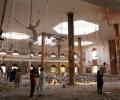
'But that was not our aim. Our objective was already achieved.'

The Pakistan army is staring at the greatest, scariest, existential threat to its power in their country. This threat has come from a populist riding democratic power, observes Shekhar Gupta.
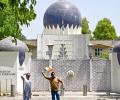
She has been booked under the relevant sections of the Official Secrets Act and the Bharatiya Nyaya Sanhita, said the police.
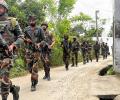
Security forces in the Jammu region are maintaining a strong vigil and conducting operations to track down 40 to 50 terrorists active in the area. Multi-tier security measures, including anti-drone strategies and intensified night operations, are in place.

Lance Naik Mohammed Naseer, 35-year-old from border district of Poonch in J&K, was hit during the firing.
India's robust air defence system effectively thwarted Pakistani attempts to target Indian installations.

India's recent missile strikes on nine terrorist locations in Pakistan and Pakistan-occupied Kashmir (PoK), including Bahawalpur, mark a significant escalation in the long-standing military tensions between the two nations. This article provides a historical overview of the Indo-Pak military confrontations, tracing their roots back to the 1947 war following India's independence and the partition of the sub-continent, and highlighting key conflicts such as the 1965 war, the 1971 Bangladesh Liberation War, the 1999 Kargil War, the 2016 Uri attack, and the 2019 Pulwama attack.

India on Sunday said it inflicted tremendous losses to the Pakistan military, including downing its fighter jets featuring latest technologies and damaging key military installations close to even capital Islamabad, during the three-day confrontation between the two sides.
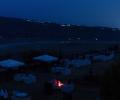
Meanwhile, a precautionary blackout has been enforfced in the multiple areas amid the esclating tensions between India and Pakistan.
Colonel Sofiya Qureshi revealed that 300 to 400 drones were deployed across 36 locations, with several being shot down by Indian forces using both kinetic and non-kinetic methods.

The worst-hit in the Pakistani shelling was Poonch district which accounted for all the civilian deaths, the officials said, adding 28 persons were also injured and the condition of some of them was stated to be critical.

The Pakistani military fired unprovoked shots across the Line of Control (LoC) in Kashmir for a second consecutive night, triggering retaliatory action from Indian troops. This escalation follows heightened tension between India and Pakistan after the Pahalgam terror attack that killed 26 civilians. Despite the exchange of fire, no casualties were reported. India has imposed a series of punitive measures in response to the attack, including the suspension of the Indus Waters Treaty and closing the Attari land-border crossing. Pakistan has responded in kind, closing its airspace to Indian airlines and suspending trade with India.

The landmine exploded when the troops were patrolling in a forward area in Digwar sector this afternoon, the officials said.

Pakistan's Olympics gold-winning javelin thrower Arshad Nadeem's Instagram account has been blocked in India owing to a "legal request" in the aftermath of the Pahalgam terror attack.
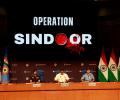
The logo for India's Operation Sindoor, which has captured the imagination of millions, was designed by two Armymen. The operation, a decisive military action against terror camps in Pakistan and Pakistan-Occupied-Kashmir, was launched in response to the Pahalgam massacre. The logo, featuring a bowl of vermilion, has become a powerful symbol of India's resolve against terrorism.
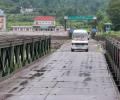
The body of Tabarak Hussain (32) was handed over two days after he died of cardiac arrest at a military hospital in Rajouri district, officials said.
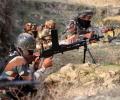
The killing of Naik Rajib Thapa, 34, raised the death toll in the cross-border firing in the past week to four -- three soldiers and one civilian.

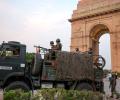
Heavy security has been deployed at vital installations in Delhi, including government buildings and areas with high footfalls, following Pakistan's drone attacks on Indian military sites. Police have strengthened vigil in areas with high footfalls and have canceled leaves for all Delhi Police personnel. The developments come after India swiftly thwarted Pakistan's attempts to strike military sites with drones and missiles.
'With the US having entered the war, raising the risks of a wider conflict, those impacts could be even more damaging.'
Bollywood celebrities have extended support to the nation and offered prayers for the safety and well-being of the people.

Pakistan's record on terrorism is "very clear" and the Pahalgam attack is only the recent example of cross-border terrorism, the ministry of external affairs said on Thursday.
